
Rhode Island School of Design
05:24
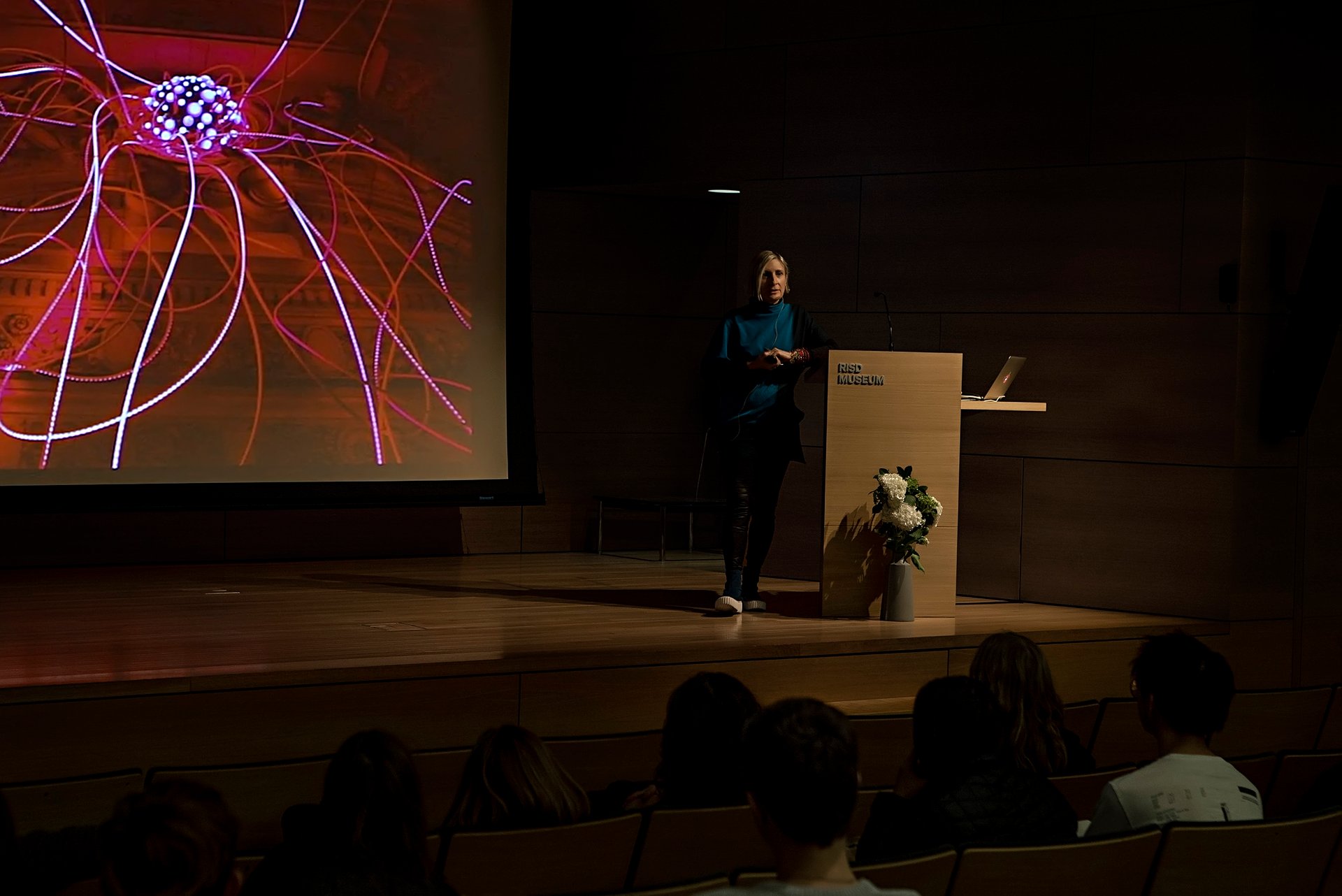
RISD Department of Fine Arts 2017 | Site-Specific Light Installations | Metcalf Auditorium, Chace Center/RISD Museum
Introducer:
Robert Brinkerhoff, Dean of Department of Fine Arts | Rhode Island, United States
The Rhode Island School of Design (RISD) is one of the most prestigious universities for fine arts and design in the United States. Consistently ranked among the best art and design institutions in the country, RISD is renowned for its rigorous academic programs, world-class faculty, and vibrant creative community.
RISD fosters innovation and experimentation, encouraging students to push the boundaries of traditional art and design practices. Through its interdisciplinary approach, the university prepares its graduates to become leaders in their fields, shaping the future of art, design, and culture.
As part of its commitment to inspiring creativity and dialogue, RISD recently hosted an artist talk featuring Grimanesa Amorós, a celebrated artist for her large-scale light installations and interdisciplinary works. Amorós shared insights into her artistic practice, offering a behind-the-scenes look at her creative process and the inspiration behind her work.
During her talk, Amorós discussed how her installations, often inspired by her Peruvian heritage, blend light, sculpture, and architecture to create immersive experiences that challenge perceptions and spark dialogue. She also highlighted the challenges and rewards of creating commissioned works, emphasizing the importance of collaboration and adaptability in her practice.
(00:17) It’s a tremendous pleasure tonight to celebrate the eternally gracious Grimanesa Amorós. Born in Lima, Peru, Grimanesa has been inspired by the important cultural legacies of her native country in shaping large-scale light based installations.
(00:34) In 2014, Grimanesa was a guest speaker at TEDGlobal, and she is a recipient of the NEA Visual Artists Fellowship and the NEA Artists Travel Grant.
(00:45) She has also had the distinct honor of being in the Art in Embassies program of the U.S.
(00:52) It is with great pleasure and pride that we host Grimanesa’s visit tonight and I must express gratitude on behalf of the fine arts division for her growing contributions and her warm, personal involvement in the RISD community.
(01:06) Please join me in providing a sincere welcome to Grimanesa Amorós.
(01:15) Thank you very much, Robert. Thank you for your kind introduction. Thank you Sheri Wills and the wonderful RISD team for organizing this lecture.
(01:26) I wanted to talk tonight about different site installations and how and when I started working with light.
(01:34) In an unforgettable trip that I did in Iceland, many years ago. It took a while, obviously, many years, to figure it out, a physical structure to share light, which is very ephemeral.
(01:46) When I moved to New York in 1984, I had the chance to live my dream, which was when I was in Peru, I used to watch a lot of the movies about the Bohemian life.
(02:03) When you are doing the lighting sequences for all the pieces that they work at the exhibition, there still has to be a communication within.
(02:12) The late Jane Farver was also the curator for the American Pavilion for the Venice Biennale in 2015. The engineer plans that we received, this one is very important because it delineates our limitations as to what we could do once we are at that location.
(02:29) I didn’t know that it was going to be polished cement, and so I was going to be getting the reflections of the water because Light Between the Islands.
(02:38) So when you went inside the space, you truly got the sensation that you’re walking in water.
(02:42) This, you know, one of the stills of the animation that I had to with my face.
(02:46) It’s extremely difficult to work with both animation and regular footage at the same time.
(02:57) Where they’re going, I find out, you know, supervisors.
(03:00) Now it’s 8 o’clock and they have to go for their coffee.
(03:08) From the two-dimensional on the dome to go to this three-dimensional way of using light and the structure for my other projects and series.
(03:18) One, two years ago. And so, Peninsula is on 55th Street and the Pope was staying at 50th Street and St. Patrick.
(03:26) So that was, you know, a very nice challenge.
(03:32) I also want to thank you, RISD, for your hospitality, and for all of you, again, your precious time to come to hear what I have said tonight.
(03:44) Thanks for sharing the story of your work and such spectacular work.
(03:47) I have a couple of questions, and I guess they’re fairly technical questions because so much of your work is driven by very complex engineering.
(03:57) So I’m curious, the dome components, what are they actually fabricated from?
(04:03) It’s what we call polycarbonate.
(04:06) What happened is that there are thousands of it.
(04:08) I used to think that there were only hundreds but as a matter of fact I talked with the Getty Museum with Conservation and Public Art and that’s when
(04:24) they actually correct me saying that there are thousands of different kinds and so I did made a research about nine months and
(04:42) it really varies each of them way they diffuse light. I have always what I call my specialized team that they always come with me. Part of the integration that
(04:52) interests me is to work with the people there because I learned a lot and they know the space much further detailed than myself or anyone that we could come that
(05:03) we have studied it digitally. I love to work with different teams of engineering in different countries and they are put more by the commission directly more than chosen by me.